
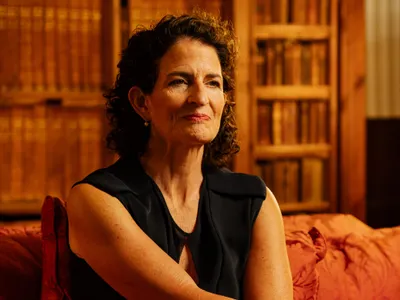
 Charlotte Gordon on Mary Shelley's Frankenstein
The Creature's Education: How Frankenstein Says We're Made
The most affecting stretch of Frankenstein is not a scene of horror but a course of study. Hidden beside a cottage, the creature teaches himself to speak, to read, and to understand the world, and in Charlotte Gordon's Rebind Classics reading, this self-education is where the novel makes its deepest argument: that what we become is shaped by what we are taught and how we are treated, not fixed in us at birth. The creature is built, but his character is made.
Lessons Through a Crack in the Wall
His first lessons come through a crack in a wall, watching a family he cannot join. Gordon delights in the irony that the being everyone calls a brute acquires language with reverence, treating words as something close to sacred. Shelley, she notes, is reminding us "that words themselves are God, that we create with words." The creature who is supposedly incapable of civilization is the one articulating the godlike power of language, learning "fire, milk, bread" and the names of human relations, father, sister, brother, that he will never get to claim.
What the creature learns, above all, is gentleness, because the family he observes is loving, and Gordon points to the reversal at the heart of these chapters: the creature, "supposed to be the barbarous one," turns out to be "the humane and gentle one," while the humans who are supposed to be civilized prove capable of barbarity. His education in kindness comes from watching kindness. The novel suggests that character is absorbed from environment, that a being shown tenderness becomes tender, which makes what happens to him next all the more damning.
A Curriculum of Three Books
The creature's formal curriculum, three books he finds, turns his education toward the largest question, and Gordon maps them precisely: Paradise Lost teaches him about God and creation, Plutarch's Lives about virtue and who deserves emulation, and Goethe's The Sorrows of Young Werther about feeling. Heaven, earth, and inner life, as she puts it. Reading Milton, the creature tries to locate himself and cannot. He "can't be Adam because he didn't have a God," no loving creator having watched over him, "but he also can't be Satan because he's like no other." His reading gives him self-knowledge that Victor never achieves, and it gives him grief.
That grief sharpens the novel's question about how a being turns from good to harmful. The creature insists, in Shelley's words, that "I was benevolent and good; misery made me a fiend." Gordon takes this seriously as a claim about causation: the creature is not evil by design but made vicious by relentless rejection. When he finally reveals himself to the family he loves, hoping to be received, they beat him and flee, and only then does he turn destructive. The lesson of his education is undone by a single act of cruelty.
Monsters Are Taught, Not Born
Gordon refuses to let readers imagine they would have behaved better than the terrified cottagers, and this is where the novel's argument about how we're made turns back on us. "We are all the cottagers," she says flatly. The instinct to strike at a frightening stranger is not rare or monstrous; it is ordinary, which is exactly the problem. She extends the point to history's worst cruelties, confessing her fear that she too might have gone along with the crowd. The creature's making, in other words, is not a freak event but a model of how communities routinely produce the outsiders they then punish.
The chapters also gesture beyond the creature to whole peoples treated as monstrous; his first history lesson, Constantin de Volney's account of empires, dwells on the destruction of conquered civilizations and "the hapless fate" of the Americas' original inhabitants. Gordon notes that some readers see the creature's features as racially coded, and that Shelley was reading accounts of enslaved people as she wrote. Whether or not the novel intends a specific allegory, Gordon reads it as fundamentally concerned with "how we treat the other, the stranger," and with the violence ordinary people do to those they have decided are not fully human.
What the creature's education finally teaches, then, is a lesson about us rather than about him. He is made gentle by kindness and made dangerous by cruelty, which means the responsibility for what he becomes lies with the people who shaped him. Gordon's recurring summary of the book applies most forcefully here: it "is about how we make monsters." The creature's schooling is the novel's evidence, a step-by-step demonstration that monstrousness is not born but taught, and that the teachers are people exactly like the reader.