
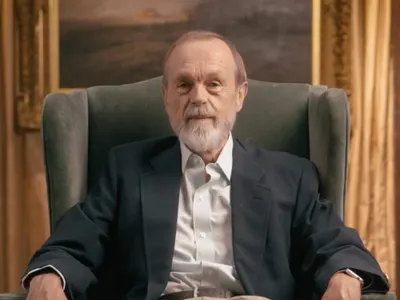
with commentary by Philip Kitcher
Philip Kitcher opens his commentary with an observation anyone who loves this book has tested at parties: "Probably the most frequent response to the question 'Have you read Ulysses?' is 'Well, I tried once, but...'". I was luckier than that. I read Ulysses through in my early twenties, a young man trying to find his way as a writer, living with a rotating cast of what I'll politely call unique roommates, and the character I thought about most was Stephen Dedalus. Of course he was. Like generations of up-and-coming writers before and since, I was intrigued by Stephen and, through him, by the path James Joyce traveled toward denser and denser literature. I didn't get many of the jokes that first time. I do recall chuckling quite often anyway.
Returning to the book now, in my forties, Stephen is still there and still magnetic. But it's Leopold Bloom who keeps coming into view, the person I find myself measuring against, in good ways and bad: the goals I've managed to reach, the failures, the fact that I am, for example, not as renowned a writer as Joyce. Bloom himself supplies the vertigo of that kind of self-audit, in a monologue Kitcher reads aloud mid-series: "I was happier then. Or was that I? Or am I now I?"
I'm aware of what it might mean that I've started standing next to Bloom. Is this what a midlife crisis is? If so, I'm in good company. Kitcher confesses that of all the characters in fiction, "there are none with whom I am as intimate as these three — above all Mr Bloom."
Here is what makes his commentary unlike every guide to Ulysses I've tried. The usual instinct is inundation: more apparatus, more annotation, more explanation layered over a book already accused of carrying too much. It never worked for me, and Kitcher begins by explaining why it misses the point. He quotes Molly Bloom's own complaint, voiced in one of the novel's easily comprehensible passages, "O rocks... Tell us in plain words," and takes it seriously as the reader's complaint too.
His first move is a word swap: for "difficult," substitute "rich" or "inexhaustible." His second is a release from a burden you may not have noticed you were carrying: "Ulysses isn't a Literary IQ test, on which ambitious readers can aim to achieve a perfect score. It's a book you can come back to over the course of a lifetime."
Then he hands you the image the whole series stands on:
"Don't think of a message concealed by some fiendish cryptographer. Think instead of a glorious tapestry, one showing an array of aspects of the world in vivid colors, something in which you could trace connections for an indefinitely long period, picking out those you find most beautiful and most illuminating."
Threads to trace, in other words, rather than a code to crack. I've long suspected something like this about allusion itself: that there's no clean boundary where allusion stops and plain language begins, that every word is threaded through everything we've read, and what varies is only whether we notice, and how noticeable an author has chosen to make the thread. My own reading is proof. I can't hear this novel's first line without hearing the last line of Richard Fariña's Been Down So Long It Looks Like Up to Me, a book that took off from ground Joyce staked: "bump bump bump, down the funny stairs."
Kitcher extends the same freedom to the famous Homeric parallels. Some are illuminating, but "the search for parallels is easily overextended"; the elaborate episode schemas beloved of annotators he calls, flatly, "a foolish quest, one that interferes with sensitive reading." His counter-instruction is the series' key word: "take on the role of co-creator. Use whatever parallels you find illuminating... Joyce wouldn't" worry, and neither should you.
The practical advice is just as unburdening. Read slowly, at a poem's pace, because Joyce is "a poet who didn't write very good verse — but who wrote extraordinary prose." Kitcher names, from decades of teaching the book at Columbia, the three exact places where readers quit, Proteus, Sirens, and Oxen of the Sun, and meets them with a blessing he borrows from the mathematician Jean le Rond d'Alembert: "Go on, and faith will come to you."
And above all, the jokes. Joyce, he reminds us, cared less whether readers understood Ulysses than whether they laughed; Nora Barnacle could hear him laughing through the wall as he wrote. "It is also extremely funny." This is where Kitcher's touch is surest: he points to where a joke lives and gets out of its way, so you arrive at the laugh yourself instead of having it explained and stepped on. The complexities open into delights to wander in. For the first time in my experience of Ulysses commentary, getting it and enjoying it are the same act.
Underneath the warmth runs a philosopher's thesis, stated in the opening episode and tested across the entire novel: Ulysses is an engine for the proliferation of perspectives. Kitcher traces the device from a single sentence in "The Dead" (Lily, "literally run off her feet," in her own words rather than a narrator's) through the interior monologue to the late episodes, where the styles unfold standpoints beyond any character, inviting us "to become co-creators with the novelist." A perspective, in his philosopher's definition, is a whole way of experiencing: what counts as connected, as salient, as valuable. Where Homer's epic holds mostly to its wanderer, Joyce's splits the one day across a city of minds.
And this is where the commentary's ethics arrive: Joyce's moral vision, Kitcher argues, rests on entering "how the world is observed and felt" by others, "a deeply humane and humanist vision," a revaluation of values that asks heroism of ordinary sympathy.
As I write this, I'm in the final volume of Marcel Proust's In Search of Lost Time, and the two projects keep illuminating each other: Proust detonates a single moment outward until it covers a lifetime, while Ulysses folds a lifetime into the confines of one day. Kitcher gives the difference a precise instrument. The other great novels show their characters across years, at a distance; Joyce puts Bloom and Stephen "under a microscope," which is why their twenty-four hours can hold so much. Both books arrive, from opposite directions, at the same sentence, one Bloom thinks at lunchtime remembering Howth Head: "Can't bring back time. Like holding water in your hand."
So, the claim I'll make outright: this may be the most welcoming, most companionable commentary on Ulysses yet produced, and it earns that not by thinning the book out but by walking its entire length, episode by episode, at reading pace, with a guide whose deepest commitment is handing the novel over rather than standing in front of it. At the end, Kitcher asks his own last question, whether the book deserves its place beside Tolstoy and Cervantes, and answers "I follow Molly's lead... Yes, Yes and Yes." His closing verdict is the one Bloom has been waiting a century for: "an advertising canvasser's journey throughout a day may be as challenging as that undertaken by a Greek wanderer, and no less worthy of a hero."
Well, I tried once. This time, go on; the faith comes. And on the last page, so does the Yes.