
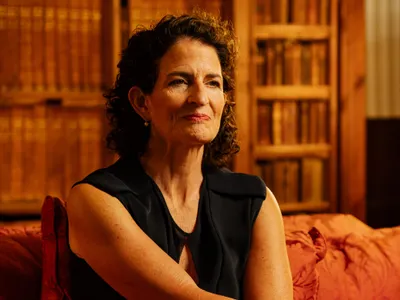
 Charlotte Gordon on Mary Shelley's Frankenstein
Wollstonecraft's Daughters: The Feminist Inheritance Inside Frankenstein
To understand Frankenstein, Charlotte Gordon argues in her Rebind Classics series, you have to understand a woman who died before its author could speak: Mary Wollstonecraft, the eighteenth century's great feminist philosopher and Mary Shelley's mother. The novel is usually read as a story about science, but Gordon hears something else running beneath it, a current of ideas about women, education, and worth that Shelley absorbed from a mother she knew only through a grave and a stack of books.
Learning to Read on a Tombstone
Wollstonecraft died days after giving birth to Mary, yet she shaped her daughter completely. Gordon describes a childhood organized around the absent mother: Mary "learned to read on her mother's tombstone," and among her first written words were "vindication of the rights of woman," the title of Wollstonecraft's most famous book. A four-year-old, Gordon imagines, sounding out a word like "vindication" and asking her father what it meant. The dead mother was everywhere in the house, in a large portrait, in her father's pride, in the reading lists Mary would later assign herself in imitation.
What Wollstonecraft Actually Argued
What Wollstonecraft actually argued, Gordon stresses, was radical to the point of danger. Writing in the 1790s and publishing anonymously, she insisted that "women deserve independence," that they "should be allowed to get an education," that they "should be allowed to earn money separate from men." She dismantled the era's reigning philosophers, telling readers in effect that when Jean-Jacques Rousseau wrote about women, "he's an idiot." Women were not made to be "the toys of men," and a society that trained them only to be decorative wives was wasting half its people.
Gordon is especially struck by Wollstonecraft's analysis of marriage, which cuts to the economics underneath the romance. In a society where women could not earn or learn, Wollstonecraft saw marriage as a transaction barely distinguishable from prostitution. Gordon paraphrases the claim that "marriage was a form of legalized prostitution," a woman trading her looks for support until the looks ran out. What Wollstonecraft wanted was for women to find meaning beyond "love, attraction, beauty," the only currencies their world allowed them, and she started schools to make it possible.
The Drumbeat Inside the Novel
This is the inheritance Gordon hears humming inside Frankenstein, even though the novel never states it. The book's surface is all creators and creatures and Arctic ice, but Gordon listens for "the Wollstonecraft drumbeat underneath all of it." She reads the fate of Elizabeth, Victor's bride, strangled on her wedding night, as a coded portrait of women's powerlessness, "an embodiment of the fate of women during this era." Shelley, raised on her mother's philosophy, built a critique of how women are silenced and disposed of into a story that looks, on its surface, like a tale of scientific hubris.
The inheritance was also a curse, because the same culture that destroyed the mother came for the daughter. When Frankenstein was revealed to be the work of a young woman, the attacks rhymed with the ones that had greeted Wollstonecraft a generation earlier. Gordon captures the cruelty of the escalation: "Wollstonecraft at least was just a whore," the reasoning went, "but now her daughter is perversion." A woman who broke the rules was punished; a woman who wrote a strange, ambitious book was called monstrous for having imagined it. The label "monster" attached not only to the creature but to the author.
The Nerve to Keep Writing
Gordon makes this personal, drawing a line from Wollstonecraft and Shelley to her own formation as a woman in a literary world that ranked female experience as lesser. At Harvard she "read only men," had one female professor, and absorbed the lesson that serious literature was made by "dead white men" while emotions and interior lives were not fit subjects. The confessional women poets she loved, Anne Sexton and Sylvia Plath, were dismissed as lower than John Milton. Her attachment to Mary Shelley, she admits, grew from recognizing a fellow traveler: a woman told she was lesser who made art anyway.
That defiance is finally what Gordon takes from the Wollstonecraft line, and what she thinks the novel quietly honors. The wonder of these women, she says, is that when a culture tells you repeatedly that "you're stupid, you're lesser than, you can't do this," some of them still do it. Wollstonecraft "somehow she knew" her own worth without permission; Shelley wrote her monstrous, enduring book at eighteen. The feminist inheritance inside Frankenstein is not a slogan but a survival, the transmission, mother to daughter, of the nerve to keep writing while the world calls your imagination perverse.