
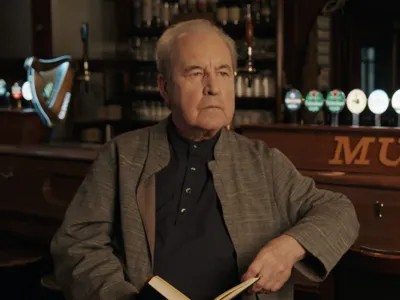
with commentary by John Banville
“The Dead” is the last story in Dubliners, and it is unlike anything that comes before it. Joyce wrote it after the rest of the collection was finished, added it almost as an afterthought, and in doing so wrote the story that many readers, and more than a few writers, consider the summit of the form. It runs to about forty pages. Its closing paragraph is quoted more often than any other page of Dubliners. And it turns, at its center, on a revelation so small (a dead boy in Galway who once stood in the snow) that you might miss it if you read too fast.
John Banville’s reading of “The Dead,” in his Rebind commentary on Dubliners, describes his first encounter with it: “I was astonished by it.” He is still astonished, he says, though differently now. “I can see how it’s done. I can see the ribs beneath the skin.” What follows is his reading of exactly those ribs: the architecture of a story that looks warm and festive on the surface and conceals, underneath, a man’s entire understanding of himself collapsing in a single night.
The Party
“The Dead” opens at the Misses Morkan’s annual dance, a January evening in Dublin, snow on the ground, a house full of music and food and the particular Irish hospitality that is, in Banville’s precise formulation, “about 85% fake, 15% of it is absolutely genuine, which is saying a lot.”
At the center of the party is Gabriel Conroy, who is a book reviewer, schoolteacher, man of mild cosmopolitan pretension, devoted nephew to the elderly Misses Morkan. He arrives with his wife Greta, who is from the west of Ireland, a detail that matters more than it first appears. He has his after-dinner speech prepared. He is looking forward, in a quietly amorous way, to the hotel room he and Greta have booked for the night; it is a rare evening away from the children, alone together in the Gresham Hotel.
Banville reads Gabriel with more generosity than most critics allow. “Gabriel is a decent man,” he says. “He’s capable of being discommoded by a serving girl. He gives her some money. He worries about his aunts, these aging ladies. He looks after Freddy Malins, who turns up screwed (horribly drunk). He has a rather high image of himself, but he’s not an inconsiderable figure.” The story does not set Gabriel up to be demolished. It sets him up to be changed, which is harder.
The Song on the Stairs
Near midnight, as the guests are leaving, the tenor Bartell D’Arcy sings “The Lass of Aughrim”, which is a slow, sorrowful ballad about a girl abandoned in the snow by the lord who made her pregnant. Gabriel, looking up from the bottom of the staircase, sees Greta standing above him, listening, motionless, in an attitude of rapt attention he has never seen before.
He is moved by the image of her. He wants her. He looks forward to the hotel room with renewed warmth. It is only later, in the bedroom, that he asks about the song, and Greta tells him about Michael Furey, a boy she knew in Galway when she was young. He had tuberculosis. When he heard she was leaving for Dublin, he came to her garden in the rain and stood under her window. She begged him to go back. He died a week later. “I think he died for me,” Greta says.
Banville reads what this does to Gabriel precisely: “He has to ask himself some very hard questions. Has he ever really loved? Has he ever known the passion? Is he like Mr Duffy in A Painful Case — has he been excluded from life’s feast?” Gabriel’s carefully maintained self-image is suddenly measured against a boy who worked in the gas works and stood in the rain because he could not bear her leaving.
“There are three people in that hotel bedroom,” Banville says. “There’s Gabriel and Greta. And then there’s the ghost of Michael Furey. And the ghost of Michael Furey seems to Gabriel more alive than he is himself.”
The Anti-Epiphany
This is the moment Banville identifies in his full Rebind commentary on Dubliners as the story’s central movement: an anti-epiphany. “He is being introduced to the world of the dead, a world of loss, an anti-world where, to his deep alarm, he finds himself not exactly at home, but not a stranger either.” Gabriel recognizes the world of Michael Furey. He understands loss and absence and the way the dead can be more present than the living. What he does not know, until this moment, is that he has always lived closer to that world than he thought.
What he sees is not despair, Banville insists. “I think this possibly presages not despair for Gabriel, but the possibility of change. One wonders what the morning is going to be like in this hotel room.” Banville imagines the next day with characteristic practicality: Greta will have snapped back to being the Galway girl she always was, will tell him not to worry about Michael Furey, that they have each other now. “What she’s saying is: we have to make the best of it. We have to make do with what we have.” It is not a transcendent conclusion. It is a human one.
The Snow
Then it begins to snow again. And Joyce writes the paragraph that has generated, as the Irish novelist Anne Enright once said, more bad writing in Ireland than any other piece of prose in the language.
Snow falls over all of Ireland. Over the dark central plain, over the treeless hills, over the Bog of Allen, over the Shannon, over the lonely churchyard in the west where Michael Furey lies buried. Gabriel’s soul swoops slowly as he hears the snow falling faintly through the universe, “like the descent of their last end, upon all the living and the dead.”
Banville’s reading of this paragraph is the center of his entire commentary. He refuses the elegiac reading: the reading that hears only death and exile in the snow falling westward. “The snow that’s falling in the last paragraph is falling equally on the living and the dead,” he says. “And there is this sense of mutuality.” He reads the paragraph not as Gabriel accepting death but as Gabriel writing his own poem: a poem of selfhood, of celebration, of a man who has been broken open and found, inside the break, something unexpected.
“This is Gabriel Conroy’s poem,” Banville says. “This is his song.”
Joyce wrote Dubliners out of rage, at least at first, a rage at Dublin’s paralysis, its petty self-satisfaction, its colonized smallness. Fourteen stories of diagnosis, fourteen stories of people who cannot move. “The Dead” is where the diagnosis softens, barely, into something else. “There is a definite intensification of style,” Banville says, “but there is also a warmer tone.” Joyce, writing in exile, had begun to wonder whether he had treated Dublin too harshly. In “The Dead,” he let it breathe.