
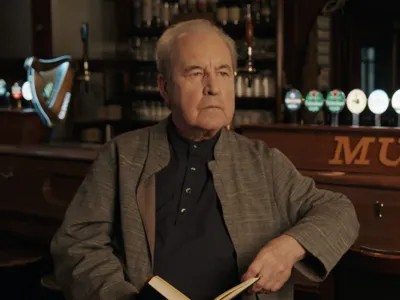
with commentary by John Banville
The question comes up every time someone decides to read James Joyce seriously. Ulysses is the book: the acknowledged masterpiece, the one everyone knows they should read and very few finish. Dubliners is the shorter, earlier book, consisting of fifteen stories, a hundred and fifty pages, written before the admirers arrived and told Joyce he could do no wrong. The question is which one to start with.
The answer, almost certainly, is Dubliners. And the reason is not simply that it is easier, though it is. The reason is that Dubliners teaches you how to read Joyce, teaches you his method, his city, his diagnosis of the people he spent his life writing about. Without it, Ulysses is a magnificent but bewildering structure you are circling from the outside. With it, you already know Dublin, already understand what Joyce thinks is wrong with it, and already have the reading skills the later work demands.
What Dubliners Is
Dubliners was published in 1914, but most of the stories were written a decade earlier, when Joyce was in his early twenties, before he had left Ireland permanently and before the circle of admirers that would later surround him had formed. John Banville, in his Rebind commentary on the collection, identifies this timing as decisive. “You could say, if you were being uncharitable, that Joyce wrote simply because he was young and inexperienced and had to write simply,” he says. “He was writing at the top of his bent. He wasn’t being economical. This is the best that he could do.”
The result is a book unlike anything else in Joyce’s career. Each story is short, clean, and precise. “These stories,” Banville says, “stand like standing stones, ancient standing stones in a field. They’re simply there. They can be interpreted in many ways, but they have their own reality. They don’t depend on theories of literature or philosophy. They are themselves, which is part of their greatness.”
What Ulysses Is, and Why It’s Hard
Ulysses is set in Dublin on a single day in June 1904. It follows Leopold Bloom, a Jewish advertising canvasser, and Stephen Dedalus, a young intellectual who is also the protagonist of Joyce’s earlier novel A Portrait of the Artist as a Young Man, through a single day in the city. It is eight hundred pages long, structurally modeled on Homer’s Odyssey, and written in eighteen different styles, each section departing further from conventional narrative.
Banville is honest about what this means for readers. “There is no denying that Joyce is intimidating,” he says in his Rebind commentary. “Much of Ulysses is overwrought, to say the least. It could slim down. It would have been a far greater book. It is, of course, the book. But it’s intimidating. It’s very long. There are many — as the French say, longueurs — many passages where your eyelids become very heavy.”
The Irish novelist Roddy Doyle once said, scandalously to some, that Joyce could have done with a good editor on Ulysses. Banville was not scandalized. “When he was doing Ulysses, people were afraid to challenge Joyce,” he says. “He fell in with bad companions who told him he could do no wrong.”
What Dubliners Teaches You
Reading Dubliners before Ulysses does several things that no amount of introduction or annotation can replicate.
It teaches you Joyce’s city. The Dublin of Dubliners is the same Dublin of Ulysses: the same streets, the same pubs, the same social world, the same class anxieties and colonial wounds. Banville describes it as “the world of the petite bourgeoisie: the lower middle class, upper working class. Feckless men going about cadging drinks, borrowing the odd sovereign from their gullible friends, trying to do as little work as possible.” Leopold Bloom moves through this world. Stephen Dedalus grew up in it.
It teaches you Joyce’s method. Dubliners is built on economy and the unsaid, on what Joyce deliberately withholds from the reader. In ‘An Encounter,’ a man walks to the far end of a field and does something unspecified, and Joyce leaves it at a single line: “I say! Look what he’s doing!” He never tells you. In ‘Eveline,’ a woman stands at a gangplank unable to board a ship, and Joyce ends on her white face without explaining her decision. This method (the weight on the gap, the meaning in the absence) is the method Ulysses uses at far greater length and complexity.
It teaches you Joyce’s central argument. The word Joyce chose for what was wrong with Dublin was paralysis. He put it on the first page of the first story, in the mind of a boy who finds it frightening and fascinating at the same time. Banville reads this as the whole collection’s thesis: “Joyce saw his city as stopped in time. His people are locked in. They’re locked in a petty contemplation of themselves and their world.” Leopold Bloom and Stephen Dedalus in Ulysses are Joyce’s attempt to imagine two people in the same city who are not paralyzed. Without Dubliners establishing what paralysis looks like, the achievement of Ulysses’ protagonists is harder to feel.
Do You Need to Read A Portrait of the Artist Too?
The honest answer is: not before Ulysses, but it helps. A Portrait of the Artist as a Young Man, published in 1916, follows Stephen Dedalus from childhood through his decision to leave Ireland and become a writer. Stephen appears in Ulysses as a young man already carrying everything that Portrait established. Reading Portrait gives you Stephen’s history; reading Dubliners gives you his world. If you have to choose, Dubliners is the more essential foundation.
Where to Start in Dubliners
If you want to read Dubliners in order, start at the beginning: ‘The Sisters’ announces everything the collection is going to do in a single first paragraph. If you want to start with the most immediately accessible stories, ‘Araby’ and ‘Eveline’ are the ones most readers respond to on a first reading. ‘The Dead,’ which comes last, is the finest thing in the book, but it earns its force from the fourteen stories that precede it.
Ulysses will still be hard. Banville does not promise otherwise, and neither does anyone who has read it honestly. But it will be a different kind of hard: the hard of a book you are inside rather than locked out of. That is what Dubliners gives you.