
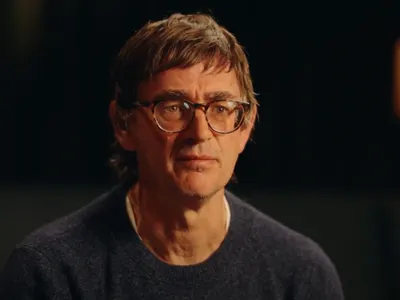
 Clancy Martin on Friedrich Nietzsche's Thus Spoke Zarathustra
The Man Who Read It to Stay Alive
Most guides to a difficult book ask you to trust their expertise. Clancy Martin asks you to trust something riskier: his life. He has translated Thus Spoke Zarathustra and taught it for decades, but the credential he leads with is not academic. "I'm the survivor of multiple suicide attempts," he says, and the book in his hands is the one he reached for in the hours when survival was in question. To understand his reading of Friedrich Nietzsche, you have to understand why he thinks the life behind a philosophy is not gossip but the only honest frame. That conviction is itself Nietzschean. Martin points out that Nietzsche made a method of reading philosophers through their lives, holding that "a philosophy is nothing more than a kind of collection of human, all too human facts about its author." Nietzsche thought it naive, even dishonest, to pretend a thinker's ideas float free of their wounds and circumstances. So Martin turns the same lens on himself, openly, and asks the reader to do the same with Nietzsche. The biography is not a distraction from the philosophy. It is the philosophy's native habitat.
Martin's own entry into the book came at fifteen, in the middle of first love and emotional awakening. He describes a childhood almost without affection. "The first time I hugged my mother wasn't until I was in my twenties," he says. "We just weren't that kind of a family. We were very unemotional." Then a girlfriend opened the world of feeling, and at the same moment he encountered Zarathustra, and the two openings fused. "It was like this moment of communion," he says. He felt he had found "the first person who had really understood me." The book did not arrive as an assignment. It arrived as recognition, at the exact age when he most needed to be recognized.
What the book became over the next thirty years is the heart of Martin's reading. Not a system, not a manual, "more like a touchstone than a guidebook," he says. He read it as a guidebook for too long, he admits, before it turned into "a series of poems that I would go back to." And he went back to it precisely in the dark. "When I was going through really rough times, when I was in despair, when I was very lonely, when I was feeling like my life didn't have meaning, I could go back to this book and be reassured that the path I was on was a path worth pursuing." The book's promise, for Martin, was that "it was possible to affirm life even during your most painful moments, even during your loneliest moments, even during your most desperate moments."
The most harrowing image he offers makes the stakes literal, pointing us to a speech in Zarathustra called On Voluntary Death; Martin has read it in the worst possible circumstances. "I've read that speech with a gun in my lap, sitting in the bathroom of my jewellery store," he says. He spent years in the luxury jewelry business, and he was, in those years, "reading Thus Spoke Zarathustra for consolation and inspiration and a sort of attempt at redemption." This is not a professor admiring a text from a safe distance. It is a man who took a book into the room where he was deciding whether to live, and came back out.
His struggles with addiction run through the commentary with the same candor. Martin speaks of a period when "I couldn't see my children because I was wrestling with alcohol addiction and was in early stages of recovery." He reads Nietzsche's account of the herd, the comfortable deadness of an unexamined life, through that experience, noting that in his suffering he was paradoxically "very alive. I was acutely conscious of my own existence." He maps his own arc onto Nietzsche's three metamorphoses, confessing that during his jewelry years he "was falling into nihilism, the truth be told," below even the rebellious pride of the lion, before recovery let him discover what he actually valued: "the love of my children and the love of the job, of being a philosophy professor, and the love of writing."
There is a reason Martin refuses to be solemn about any of this, and it is a reading strategy as much as a temperament. "If I take that too seriously, it's just a little too farcical," he says of his own survival. With five children, a partner, and the "ludicrous profession" of professing to illuminate the greatest minds in history, he finds that taking himself too seriously would make him "feel hopelessly incapable." He reaches for Camus: looking at your own life can be like watching someone "losing his temper in a phone booth, but you can't actually hear what he's losing his temper over." The absurdity is real. The lightness is how he keeps reading, and living, anyway.
This is what makes Martin an unusual guide and, for many readers, the right one. He does not offer Zarathustra as a monument to be admired. He offers it as the thing that worked, the book that talked him through despair when nothing else held. His instruction for how to read it follows directly from that: not front to back like a textbook, but entering "where it grabs you," looking for the passages that mirror your own longing and confusion, the way you would read poetry rather than a manual. Martin can teach the book this way because he has used it this way. The life is not beside the point. For Clancy Martin, the life is the proof that the book can do what Nietzsche promised: help a person affirm a life that, by every external measure, had given them reasons not to.