
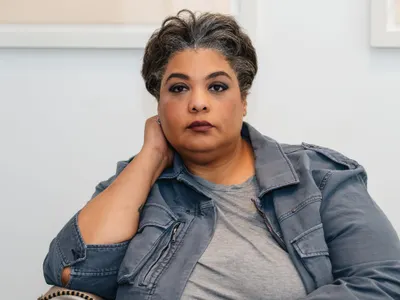
with commentary by Roxane Gay
As I write this, I'm looking at a painting: an eighteenth-century portrait by Sir Joshua Reynolds of a small girl sitting at the edge of a wood, hands crossed over her heart, looking off at something we can't see. Edith Wharton is thought to have taken the title of her 1920 novel from this painting. But here's the detail I can't get past: Reynolds didn't call it The Age of Innocence. The painting was known as A Little Girl. The famous title was applied later, by other people, after the painter was done with it.
I always knew Wharton's title was ironic. Every reader clocks that much. But I'd never confronted the source, and the sharpness of the irony didn't land until I sat with the painting itself. Innocence wasn't in the picture. Innocence was a caption, added afterward, by people who needed the picture to mean something. Which is, it turns out, a fair description of what old New York does for four hundred pages: assign innocence, to its daughters, to its rituals, to itself, and enforce the caption. I've spent a lot of my writing life tracing things back to their origins and finding the origins aren't clean. This time the tracing starts on the title page.
Roxane Gay has read The Age of Innocence "probably 30 times now." Wharton is her favorite writer, and this is her favorite Wharton, the book she uses to teach her students "how to give the reader almost everything they want, but not everything they want." Thirty readings might suggest reverence. What they've actually produced, across her Rebind commentary, is the least reverent, most alive reading of Wharton I've encountered. Early in the first episode, describing what these Gilded Age New Yorkers do all day, she says something that stopped me cold:
"It's a strange analogy to make, but in many ways they're like content creators today on social media who make themselves their business. And so they spend their entire day and night creating content about themselves, reading the comments about themselves, thinking about what else they can do in order to produce more content about themselves." — Roxane Gay
I'd always read Wharton as transportation: a beautifully appointed time machine back to another world, where human failings played out in period dress. Gay refuses the distance. The novel opens at the opera, and her point about that opening is that nobody in it is watching the opera: "more than anything else, the people in this novel are watching each other." Nothing in this world is done for pleasure, she observes, not food, not travel, not even falling in love; everything is produced for an audience. Gossip is "actually currency." Status is the entire economy.
And Newland Archer, the cultivated protagonist with two last names, gets the most current diagnosis in the series: "He's a Nepo baby," Gay says, and, in fairness, "there's nothing wrong with Nepo babies. It's not your fault who your parents are." He's just one "who's never really done anything to sort of distinguish himself as remarkable." An entire critical tradition on Wharton's leisure class, retired in three sentences. As she puts it: "the more things change, the more they also stay the same."
The second thing Gay does, and for my money the most important, is hand the novel back to its women. The book runs through Newland's eyes, and Newland, she notes, keeps May Welland and Ellen Olenska "under a glass dome, sort of studying them with curiosity when in fact they are full adults." Her counter-reading starts from a plain accounting of what power these women actually had:
"When your world is prescribed for you, when it's kept small, you are going to do whatever you can to take up as much space as possible within that small world." — Roxane Gay
From there, the whole novel rearranges itself. Ellen, home from a ruinous marriage, gets "painted with a scarlet D" by a society that would rather she stay with an abusive husband than say the word divorce out loud; when asked why Ellen loves Newland at all, Gay answers that she doesn't, quite: "she's in love with the idea of safety."
And May, the supposedly blank bride, turns out to be the novel's quiet grandmaster. "The reality is that May is the orchestrator of everything that happens from this point on," Gay says of the closing movement, reading May's famous tranquility for what it is: "she's about to put the screws to him. So of course she's tranquil, because she's like, we're going to swoop in for the kill." Anytime you switch the gaze from male to female, Gay tells us, "the story changes entirely." Under her gaze, a love story becomes a chess game, and the man who thought he was playing turns out to be a piece.
Then there's the redistribution of sympathy, which is where Gay's reading gets its title for the final episode: Save Your Pity. "Let's not cry for Newland Archer. He's living a very good life." Asked at the end whether she cries for him: "I sure don't." Her sorrow goes elsewhere: to May, "who knows that she is not her husband's first choice and that he stays with her out of obligation"; to Ellen, "who is treated like a pawn in everyone else's chess game"; and, in a move very few readers of this novel ever make, to the invisible people underneath it, "the people that made them wealthy, the people on whose backs they earned all of those millions of dollars," the servants Wharton deliberately keeps at the edge of the frame to show us how completely her characters fail to see them.
You can hear how contemporary Gay's register is. Newland announces he'll survive losing Ellen as long as he can have her once, and Gay's full commentary is: "Okay, bro." This could sound like judging, and to a degree it is; it's honest judgment. But spend the hours with her and you find the judgment is a doorway rather than a verdict.
Wharton, Gay argues, "judges them and makes clear that we should judge them, but she also gives them humanity and doesn't just villainize them and make it easy for us to dismiss them." And then the line that reframes the whole series: "It's very easy to dismiss something or someone. It's very easy to judge. And it's much harder to extend empathy and to consider that, you know, everyone is human." None of it makes these people good, or their choices okay. It makes them legible: people who "think that they have free will or want to have free will" while knowing the price of using it, caught in a world that makes you choose between your happiness and what's expected of you, and shows you exactly what each one costs.
Near the end, she circles the title the way I've been circling the painting. "There are all kinds of innocence here in some ways," she says. "The sort of innocence of privilege." Even Newland's obliviousness qualifies: his ignorance "could absolutely be framed as a kind of innocence," the innocence of a man who has chosen to believe he's merely a cog in the machine that was built for his comfort. Innocence, in this book, is never a fact about a person. It's a story someone tells, for a reason, and the reason is rarely innocent.
I'm looking at the girl in the painting again. She isn't innocent. She's just young, and looking at something outside the frame. The caption came later, from people who needed it. Wharton borrowed that caption and hung it over the sharpest society portrait in American fiction, daring us to notice what it covers. Roxane Gay has been noticing for thirty readings. Sit with her and you won't be able to stop noticing either, in the book, or after you close it.