
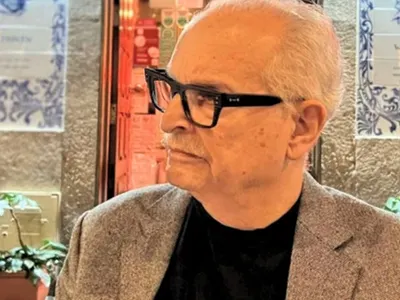
 Paul Guyer on Immanuel Kant
Kant's Radical Evil, and Why It Is Not Original Sin
By the 1790s Immanuel Kant had built a moral philosophy resting entirely on human freedom: we are free, and therefore responsible, and therefore capable of the good. Which raises an uncomfortable question. If human beings are so free to be good, why are they so reliably bad? Kant's answer, in Religion within the Boundaries of Mere Reason, is one of his most provocative ideas: radical evil. It is not an inherited stain but a freely chosen propensity to put self-love above the moral law — which is why, despite appearances, it is the opposite of original sin. Paul Guyer explains what it means, and, just as importantly, what it does not mean, because the great poet Johann Wolfgang von Goethe misread it, and Guyer thinks most readers still do.
Radical Means Rooted, Not Extreme
The word radical here does not mean extreme. It means rooted. Kant's claim, in the passage Guyer quotes, is that "this evil is radical, because it corrupts the ground of all maxims." It lies at the root of how we choose. And it is, Kant says, "as a natural propensity, inextirpable by human powers," yet "it must be possible to overcome it, since it is found in man, a being whose actions are free." That last clause is the whole point. Whatever radical evil is, it cannot cancel freedom, because freedom is precisely what makes us able to overcome it.
To see what Kant is actually claiming, Guyer sets him against the tradition. Naturalistically minded moralists, "from Seneca, who was a Roman Stoic, to Rousseau, who he classifies as a modern cynic," had a simpler picture: human beings are part of nature, and the cure for our troubles is to get back to nature, to simplify our desires until they are easy to satisfy. Guyer explains that Kant calls Rousseau a cynic not as an insult but in the ancient sense, after Diogenes, meaning one who thinks "the secret to happiness is keeping one's desires as simple as possible." Kant's objection is that this misses the decisive fact about human beings. We are not only part of nature. We also have "this transcendental freedom to choose one way or the other, no matter what the history of nature in the first sense would indicate." You cannot simplify your way out of evil, because evil is not a matter of unruly desires but of free choice.
One Fundamental Choice, Three Grades of Evil
That choice, in Kant's analysis, is structural. Guyer explains that behind all our particular choices lies one fundamental maxim, and there are only two options: "whether to subordinate self-love to morality, or alternatively whether to subordinate morality to self-love." Radical evil is the propensity to invert the correct order, to make morality conditional on self-interest rather than the reverse. And Guyer stresses that this propensity, precisely because it "must ultimately be sought in a free power of choice," is itself something we are responsible for. It is not a defect we suffer but an orientation we adopt.
Kant maps the propensity into three escalating grades, and Guyer walks them. First, frailty, "the general weakness of the human heart in complying with moral maxims." Second, impurity, "the propensity to adulterate moral incentives with immoral ones." Third, depravity, "the propensity to adopt evil maxims." The first grade sounds like ordinary weakness of will, the ancient predicament Guyer illustrates with a line from the Aeneid: I see the better and approve it, yet I follow the worse. But Kant does not accept even that comfortable excuse. On his view, Guyer explains, what we want to pass off as mere weakness "must in fact be due to the absence of a complete underlying commitment to the moral law." There is no innocent frailty. There is only a will not fully committed.
Hang: The Word That Won't Sit Still
The German word at the center of all this is Hang, propensity, and Guyer is delightful on how slippery it is. Consulting a good German dictionary, he found that the word, as he puts it, "got like 20 different meanings." It can mean "the proclivity of a cliff, or the angle of an incline"; it can mean "a disposition to do something"; it can even mean "addiction." Guyer notes that someone has argued radical evil should be translated as "addiction to evil," but he disagrees. The word will not sit still, which is fitting for a concept describing a tendency that is neither simple nature nor simple choice but something stranger sitting between them.
Why Radical Evil Is Not Original Sin
Here is the central correction, and it is where Goethe went wrong. When Goethe read the Religion, Guyer recounts, "he was shocked. He thought that Kant was giving in to the Christian idea of original sin." But that reading gets Kant exactly backwards. "Kant's whole point is this is not this." Original sin, in the traditional doctrine, is inherited: a corruption passed down from Adam that we bear before we ever choose. Kant's radical evil is the opposite. It is a free choice, made by each person, for which each is responsible. Kant even glosses the Adam story to say so, quoting the Latin tag Guyer's script preserves: "Change the name and the story is about you." The fall is not a historical event we inherit. It is the structure of every free act that subordinates morality to self-love. Kant is not endorsing original sin; he is dismantling it and rebuilding it as a doctrine of freedom.
And because it is grounded in freedom, radical evil comes with a permanent escape hatch. "Even having chosen evil," Guyer says, "which the anthropological, empirical evidence suggests most people have done most of the time, nevertheless you remain free to choose good." The same freedom that makes us capable of inverting the moral order makes us capable of righting it, in what Kant calls a revolution of the heart. Guyer connects the political stakes through Kant's image of the crooked timber of humanity: subjects can be kept in line by a good legal system, but the people in power are "made of the same crooked timber as everybody else," and for them there is "no external solution," only correct concepts, experience, and goodwill, which "cannot be externally imposed." Guyer lets the point land in the present: "we see what happens now, of course, when we have people in positions of power who have no sense of moral obligation."
So Kant's radical evil is not gloom about human nature and not a smuggled theology of inherited sin. It is a claim about freedom pushed to its hardest edge: that the same liberty that dignifies us also lets us corrupt the very root of our choosing, and that no institution can fix this for us, because the choice, evil or good, is always ours to make again. Guyer's reading rescues the idea from Goethe's misunderstanding and hands it back its actual, unsettling meaning. We are not fallen. We are free, which is worse, and also our only hope.