
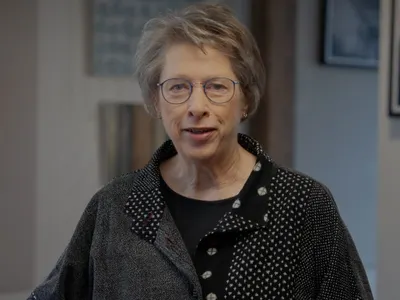
with commentary by Megan Marshall
Is The Scarlet Letter a feminist novel?
Yes, in Megan Marshall's reading, and she is exact about what the yes covers. Hawthorne gave Hester Prynne the only free mind in the book, and the ideas in it are Margaret Fuller's, taken from the most radical feminist argument of his decade. The qualification comes with the claim. Finding Hester "a feminist heroine," Marshall says, is "a more recent reading, my reading, our readings," and Hawthorne's first readers saw nothing of the kind. They read a parable about sin and what it does to the sinner. We read a woman with a mind of her own, and "he is making this into a feminist parable," Marshall says. The book holds both readings, and her case is that the second was in it from the start, waiting for readers who could see it.
The qualification has a family history too. A man wrote this novel, and a man with a particular inheritance. "One of the horrible things that one of Hawthorne's ancestors did in the Puritan time was, from what I've read, he ordered that a woman's tongue be cut out," Marshall says. "The idea that women shouldn't be allowed to speak was something that he endorsed. And then here we have Hawthorne himself, creating characters going around preaching a gospel of equality of the sexes." The descendant of a man who silenced a woman wrote the book in which a woman does the thinking. Marshall reads The Scarlet Letter partly as atonement for that inheritance, and the feminism of the novel as bound up with the expiation. The sections that follow are about how he does it, and about the one thing he could not bring himself to do.
Hester Prynne as a feminist heroine
The evidence is a chapter, the thirteenth, in which Hester, seven years into her punishment, starts to think. Hawthorne writes that her life had turned from passion and feeling to thought, that the world's law was no law for her mind, and that the Puritan fathers would have held her speculations a deadlier crime than the one on her breast. Marshall knows where those speculations come from. "Here's a place where we really do see Hawthorne borrowing from Margaret Fuller's great feminist work, Woman in the Nineteenth Century," she says. Fuller published it in 1845. Hawthorne published The Scarlet Letter in 1850, and in Marshall's reading he is lifting the most advanced theory of his moment and placing it in the head of a Boston outcast of the 1640s.
She reads the program out loud. Hester asks whether existence is worth accepting for "the whole race of womanhood," even the happiest among them, and answers no. Then the steps: the whole system of society to be torn down and built up anew; the very nature of the opposite sex, "or its long hereditary habit, which has become like nature," to be essentially modified; and woman herself to undergo a still mightier change. Marshall stops on the middle one. "That's so modern," she says. "Gender is socially constructed." The novel does more than sympathize with Hester; it thinks alongside her, at the front edge of its own decade.
How much of Hester is Fuller herself? Marshall's answer is careful. Fuller was a friend; she stayed with the Hawthornes at the Old Manse in Concord. "Is Hester Prynne a kind of avatar of Margaret Fuller?" Marshall asks, and then draws the line: "I don't think that Hester is a replica of Margaret Fuller." Hawthorne had the novel in mind before Fuller sailed for Europe in 1846. But he was "fully aware of her really radical feminist theory," which is "echoed in much of what Hester has to say about women's lot." And the timing is hard to put down. Fuller went to Rome, fell in love with a young soldier of the Roman republic, had a child with him in secret, and was forced home when the republic fell in 1849. "Just at the time that Nathaniel Hawthorne was fired from the Custom House, the Roman Republic fell," Marshall says, and the news of Fuller's child reached Concord while he was writing a novel about a woman with a child and a secret. One more thing, which Marshall says is not often known: "Pearl was a nickname for Margaret."
She will not go further than that. The critic Thomas R. Mitchell argued in Hawthorne's Fuller Mystery that Hester simply is Fuller and that Hawthorne was in love with her. "I just don't agree with that," Marshall says. What she keeps is smaller and firmer: a novelist who knew the leading feminist thinker in America, watched her life come apart in the shape of his plot, and gave his heroine her ideas.
Then there is the thing that marks Hester at all. The sign of her sin is a pregnancy; the same act left Dimmesdale unmarked, and he kept his pulpit. Marshall hears a question under the book that Hawthorne could not have asked in our words, "should women be able to live fully sexual lives the way men do?", and she is careful about the anachronism: "I don't think Hawthorne was envisioning those very issues, which became much more alive after his time." But a woman punished in public for what her body made visible is a structure that keeps turning up in arguments he never heard.
And behind Hester stands a real woman. The rosebush at the prison door, Hawthorne says in the first chapter, may have sprung up under the footsteps of "the sainted Ann Hutchinson," as he spells her, the preacher banished from Massachusetts in 1637 for claiming the spirit spoke to her without a minister in between. Marshall calls the choice of that adjective "really important." Hester's crime, like Hutchinson's, is a mind of her own. "If there's anyone with human dignity and a mind of their own, her own, it's Hester Prynne."
Or get everything
Membership
$79 a year
The rest of this essay, every episode of Megan Marshall on The Scarlet Letter, and every audio series, film and essay on the site.
“If there’s anyone with human dignity and a mind of their own, her own, it’s Hester Prynne.”
Megan Marshall7-day money-back guarantee.