
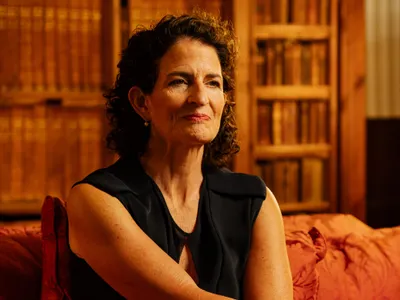
with commentary by Charlotte Gordon
Charlotte Gordon did not expect to end up at a séance. She was a biographer, a literary scholar, a Harvard-educated woman who had spent years in the company of dead women (Mary Wollstonecraft, Anne Bradstreet, Mary Shelley) trying to excavate their lives from beneath the accumulated indifference of centuries. She was skeptical by training, cautious by experience. But she was also, at the time, stuck. Her first book, a biography of the Puritan poet Anne Bradstreet, would not come. She had the facts. She had the letters, the sermons, the domestic records. What she could not find was the voice: that sense of intimate access, of genuine contact, that distinguishes biography from mere chronology.
Then a friend who ran a hair salon in Gloucester mentioned that a medium was coming. Gordon went.
They sat in a circle. People offered a name, a place, and the medium responded: oddly practical advice, Gordon recalls, furniture tips that made people sob. When it was her turn, there was no furniture discussion. The medium said he was getting a strong sense of neglect. Did that mean anything to her? It did: Anne Bradstreet had been minimized and dismissed for centuries. He mentioned scrolls: vellum, the way people wrote then. A very strong religious feeling. And then, quietly: she wants you to know it's all right.
Gordon finished the book shortly after. She felt, she says, that she had been seen. That Bradstreet had seen her.
She tells this story in her Rebind commentary on Frankenstein, and at first it seems like a digression: a charming personal aside from a biographer who is also, clearly, a natural storyteller. But the more you sit with it, the more it reveals itself as the center of everything she is saying about Mary Shelley's novel. Because Frankenstein, Gordon argues, is precisely a book about this problem: what does it mean to bring the dead back to life? What does it cost? And what happens when the person attempting the resurrection cannot face what he has made?
Mary Shelley was eighteen years old when she began writing Frankenstein during a rain-soaked summer in Geneva, 1816, cooped up in a villa with Percy Shelley, Lord Byron, and Byron's physician, John Polidori, while a volcanic winter blanketed Europe. Byron proposed a ghost-story contest. Percy got bored and went back to writing about himself. Byron got bored and went back to writing about himself. Mary kept going.
Gordon wants you to understand why. Not the mythologized version (the dream that supposedly delivered the novel whole, a story Shelley invented fifteen years later to distance herself from the scandal of having created something so monstrous) but the actual biographical logic. Mary Shelley had been living inside questions about death and resurrection since childhood. Her mother, the revolutionary feminist Mary Wollstonecraft, died ten days after giving birth to her. Mary learned to read, the story goes, by tracing the letters of her mother's name on a gravestone. She had Wollstonecraft's portrait on the wall, her books on the shelf, her ideas absorbed so completely they were indistinguishable from her own. She was in a relationship, from infancy, with a woman she had never met.
Gordon, who wrote Romantic Outlaws, a dual biography of Wollstonecraft and her daughter, has spent decades thinking about this inheritance. And what she sees in Frankenstein (what most readers miss, she argues, because they come to the novel looking for science fiction or Gothic horror) is a book haunted by the mother. Victor Frankenstein's crime is not that he creates life. It is that he creates life and then abandons it. He looks at what he has made, is overwhelmed by its ugliness, and flees. He spends the rest of the novel running from what he is responsible for.
This, Gordon says, is what the 19th century did to women. Elizabeth, the novel's central female figure, exists only in relation to the men around her. She has no inner life the novel bothers to render. She is a domestic angel, a function, a placeholder for connection. And she is strangled. Her absence is the novel's real argument. Frankenstein is a dystopia in which women have been so thoroughly silenced that the world has been left to the unregulated ambition of men, with catastrophic results. It is a continuation of A Vindication of the Rights of Woman, written in monster form because the political climate of 1818 made it impossible to write it any other way.
All of this is compelling literary history. But it is the séance story, and what Gordon draws from it, that makes her reading of Frankenstein something more than scholarship.
She says that what the medium gave her was not information but permission. Permission to pursue a dead woman across the centuries, to inhabit her perspective, to speak on her behalf — to do, in other words, what biographers do, but with the full weight of its strangeness acknowledged. She calls biography a kind of incarnation. An attempt to bring the dead back to life. She is aware that this sounds grandiose; she is also aware, having spent her career doing it, that it is genuinely the right word. Henry James, she notes, famously called biographers invasive: trespassers on private lives. Gordon has always feared he was right. The séance told her, or seemed to tell her, that Anne Bradstreet wanted to be found.
Victor Frankenstein also wanted to bring the dead back to life. He also felt, in the grip of that obsession, that his mission was righteous: that what he was doing was for the benefit of humanity, that the ends justified the extremity of the means. Gordon does not press the parallel too hard, but it is there in every page of her commentary, hovering: the question of what separates legitimate resurrection from monstrous hubris. What is the difference between Gordon in the hair salon, hoping Anne Bradstreet will speak, and Victor in the charnel house, assembling his creature from stolen parts?
Gordon's answer, I think, is love and humility. She approaches her subjects with veneration. She is always asking whether she has the right, always afraid of trespassing, always alert to the ways in which a biographer can distort what she is trying to illuminate. Victor feels none of this. His creation is a feat, a triumph, a proof of concept — until the moment it isn't, at which point it becomes an abomination he refuses to claim. He never once asks whether he has the right. He never once considers what the creature might need from him, what it might mean to be created and abandoned. He is, in Gordon's reading, the nightmare version of the biographer: someone who raises the dead and then cannot bear to look at what he's done.
Charlotte Gordon came to Mary Shelley sideways, the way she comes to all her subjects: through the mother. She had been teaching a course on women in literature and noticed, in the Norton Anthology, that Mary Wollstonecraft and Mary Shelley were listed in separate sections: Enlightenment and Romanticism. She had not known they were mother and daughter. The discovery sent her back to Wollstonecraft, and Wollstonecraft sent her to Shelley, and Shelley sent her to Frankenstein with new eyes.
She did not fall in love with the novel immediately. She says this honestly, with the same honesty she brings to the séance story, to the story of being sexually harassed by Derek Walcott, to the story of writing her senior thesis on Doris Lessing and being treated as a crank for it. Gordon is a biographer who does not leave herself out of her biographies. She knows what it is to be the woman whose voice is not taken seriously. She knows what it is to be told that the writers she loves (the confessional ones, the female ones, the alive ones) do not count. Her commentary on Frankenstein is, among other things, a reckoning with the long history of that dismissal, and an argument that Frankenstein is one of the great feminist documents in the English language precisely because it renders that dismissal as catastrophe.
The creature, she reminds us, is not the monster of the movies: he is eloquent, sensitive, hungry for beauty and connection, radicalized by neglect. He becomes monstrous only after he has been rejected so completely that monstrousness is the only available identity. He is, in this reading, what happens to any consciousness (any woman, any body, any voice) that is created and then refused. Victor made him and looked away. The world refused him and looked away. And the world was destroyed.
The séance, finally, is not a digression but the essay's argument stated in another register. Gordon sat in a circle and waited to be acknowledged by someone long dead, someone whose neglect she had spent years documenting and trying to repair. A voice said: she sees you. She wants you to know it's all right. Gordon went home and finished the book.
That is what Frankenstein is asking, in its oblique, Romantic, monstrous way: what would it mean to really see what you have made? What would it mean to stay in the room?