
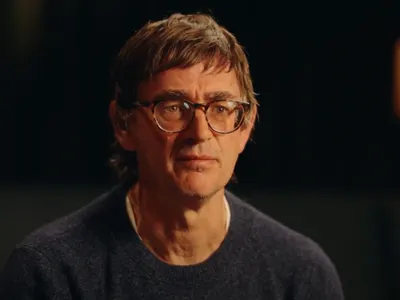
with commentary by Clancy Martin
There is a bar in Lowell, Massachusetts called Old Court, and on a warm afternoon some years ago, Clancy Martin and I were sitting outside it when he said something that changed the direction of my writing life. We had been talking about Friedrich Nietzsche (we were always talking about Nietzsche) and about the Alps, where the philosopher had done some of his best and most desperate thinking, and where Clancy had spent time walking and reading in his twenties. He looked at me and said: Hiking with Nietzsche. Just that. A title, a dare, an idea handed across a table like a key.
Hiking with Nietzsche became a book about two journeys to the Swiss Alps in search of the philosopher, one I made at twenty, reckless and half-formed, and one I made at thirty-six, married, a father, heavier in every sense. The book is, at bottom, about what happens when you return to something you once loved and find that you are no longer the person who loved it. Clancy gave me that book. He gave it to me because he had already been living it for decades, had already understood something I was only beginning to grasp: that the relationship between a reader and a great book is not static, not a thing you complete, but something that evolves with you across the full length of a life, changing shape as you change shape, becoming something different at fifty than it was at fifteen, without ever quite becoming something else.
Clancy is a philosopher, a novelist, a translator, and, by his own reckoning, offered with the bluntness that is one of his signatures, a survivor of multiple suicide attempts. He has been divorced twice. He spent six miserable years in the luxury jewelry business in Dallas before escaping back to graduate school. He has five children. He once declined to shake Benjamin Netanyahu's hand at a ruby mine in the mountains somewhere. He has read Thus Spoke Zarathustra every year or two since he was fifteen years old, a period now stretching across four decades, and he does not think he will stop.
He first encountered the book during what he describes as his first real love affair, at fifteen or sixteen, when a girlfriend was opening him to emotional worlds his family had sealed off. "The first time I hugged my mother wasn't until I was in my twenties," he has said. "We were very unemotional." Into this emotional thaw came Zarathustra, the book Nietzsche composed in a state of pure inspiration, hiking in the mountains, transcribing what felt to him like dictation from another source. For the teenager Clancy, it arrived as revelation: "I felt like I was discovering myself and I was discovering the first person who had really understood me." He had read Eastern philosophy (Taoism, Vedic texts) and had been prepared by their turning-away from the material. But this was different. This was a Western voice, from his own tradition, doubting God as he was doubting God, and telling him that the doubt was not forbidden, was not evil, was in fact the beginning of something.
He read it naively, he says. As a manual. As a guidebook. He would not fully register for years the insistence woven into Zarathustra's teaching that no one should become his disciple (this is my way, which is yours), that the book does not want to be followed, only inhabited. The young Clancy followed it anyway, and perhaps that was the right mistake to make, at that age, with that hunger.
What does it mean to carry a book across forty years?
It is not the same as expertise, though Clancy eventually became a Nietzsche scholar, wrote his dissertation on truth and deception in Zarathustra, and produced a translation of the text. Expertise is a relationship to a work's meaning; this is something else, a relationship to a work's company. Clancy describes the book the way some people describe a long friendship: it has accompanied him through states it could not have anticipated, said things to him he was not ready to hear until he was, told him the same sentence that meant one thing at twenty-five and something different at forty-five.
During the six years in the jewelry business, years he calls the unhappiest of his life, years of riding elephants to ruby mines and worrying about credit scores, of watching his intellectual life flicker like a bad connection, he clung to Zarathustra the way a sailor clings to rope. Not for answers. For tethering. "I felt like it was connecting me to reality," he has said, and the word reality is doing heavy work there. Reality, for Clancy, is not the material world of business and balance sheets but some other world, the world that great books keep open even when everything around you is trying to close it.
The suicide attempts he mentions with characteristic directness, and with a logic that is itself Nietzschean. "If I took that too seriously," he says, "it's just a little too farcical. And I would actually say, okay, come on, no more suicide attempts. Let's just find a tall building and put an end to this." The spirit of gravity, the force Nietzsche warns against most strenuously in Zarathustra, the force that causes the tightrope walker to fall, is the force that makes life feel too heavy to bear. Clancy's strategy against it is irony, is humor, is the refusal to let the weight settle permanently. He has said: "If I look at my life with a serious eye, it would be very difficult for me to keep going." He means this as a compliment to irony. He means it as a survival philosophy. And it is, I think, something he learned, or confirmed, from a book he has been reading since he was fifteen.
The metamorphosis Clancy describes in his reading of Zarathustra maps almost exactly onto the book's own central image: the three transformations of the spirit, from camel to lion to child. The camel kneels in the desert and loads itself with the heaviest things it can carry, burdens willingly assumed, the great books, the hard questions, all the weight of inheritance. The lion fights for freedom, clears the ground. But only the child creates. Only the child, who forgets, who plays, who spins like a self-propelling wheel with no purpose outside its own motion, only the child makes something new.
At fifteen, Clancy was the camel, taking on the full weight of Zarathustra, submitting to it, carrying it. In the jewelry years he was the lion, using the book to fight off a life that wasn't his. By the time he became a teacher and translator, by the time he began reading the book as poetry rather than doctrine, finding in it a series of questions rather than a set of answers, by that time, something of the child had entered his reading. He reads it now, he says, the way he might read Dickinson: not sequentially, but by finding the passages that call to him in the present moment and beginning there. He does not always finish it. That no longer feels like failure.
In one of our conversations about Zarathustra's chapter on friendship, the section where Nietzsche writes that "I and me are always too earnestly in conversation, how could it be endured if there were not a friend?" Clancy mentioned me. "I get into these conversations with myself," he said, "and then I talk to my friend John. And John pulls me back to reality a little bit." I did not know he was going to say this, and I will not pretend it didn't move me. The compliment is double-edged in the way Nietzsche intended: the friend's job is not to agree, but to interrupt the echo chamber, to be the third presence that prevents the I-and-me conversation from spiraling downward.
This is what Clancy did, that afternoon outside Old Court. He interrupted the conversation I was having with myself about Nietzsche, a conversation that had been going on since I was a young man, that had its own gravity, its own closed loop, and said something that forced it open. Hiking with Nietzsche. A title that contained a question: why do you keep returning? What are you looking for, the second time, that you didn't find, or didn't know to look for, the first?
I did not know the answer when I wrote the book. I am not sure I know it now. But I know it was Clancy who asked it. And I know that only someone who had been returning to the same book for four decades, finding it different each time without finding it diminished, could have known to ask.
There is a passage in the interview transcripts Clancy recorded for Rebind, the platform we built together to pair great books with the thinkers who have lived inside them, where he talks about what Zarathustra became for him in his darkest times. Not an answer. Not a solution. A reassurance: "that the path I was on was a path worth pursuing, that this kind of meaning was available to human beings. That it was possible to affirm life even during your most painful moments, even during your loneliest moments, even during your most desperate moments."
That is not a scholarly claim. It is not an argument. It is what a book becomes when it has been carried long enough: not an object you hold, but a relationship you inhabit. Clancy has been in a relationship with Thus Spoke Zarathustra for forty years. He has read it as a teenager in love, as a miserable businessman, as a graduate student, as a professor, as a translator, as a novelist, as a father, as a survivor. The book has not stayed the same. He has not stayed the same. What has stayed is the returning — the willingness to open it again and find out who he is now, what it says to him now, what he is willing to carry.
He gave me a title outside a bar in Lowell. He gave me a book I could only write because he had already taught me, without knowing he was teaching me, that some books don't end. They just keep going, somewhere alongside you, patient and inexhaustible, waiting for you to catch up to what they always knew.
Marcel Proust, who thought harder about reading than almost anyone, suggested in his essay On Reading that a great book functions as a kind of optical instrument — not a window onto the world but a lens that makes it possible for the reader to discern what, without the book, he would perhaps never have seen in himself. What strikes me about Clancy's forty years with Zarathustra is that the book keeps functioning as that instrument across an entire life, not once but repeatedly, revealing something different each time because the eye behind the lens has changed. Proust also noticed, in the same essay, that the books we carry longest come to preserve not only their own wisdom but the memory of the hours in which we first read them: the afternoon sun dimming in the blue sky, the untouched food on the bench beside us, the dinner we had to go home for but didn't want to. The book becomes a record of who we were, a calendar of the self. Clancy has kept that record for four decades. It is not nothing that Nietzsche, who wrote about the courage required to affirm your own life, all of it, even the parts you would not have chosen, is the one he has kept faith with.