
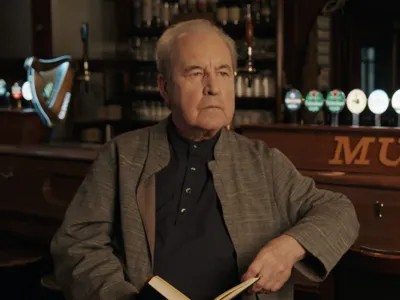
with commentary by John Banville
I went to Dublin in the autumn to meet John Banville, and I walked to him along the kind of street James Joyce wrote about — narrow, brown, "conscious of decent lives within." North Richmond Street is still there, still blind at one end. The Christian Brothers' School has been turned into something else, but you can stand at the dead end and feel what a Dublin boy in 1905 might have felt, which is that the city was a polite, exhausted face turned away from the wider world. By the time I rang the bell at Banville's door, I had been carrying the first paragraph of "Araby" in my head like a small, heavy stone.
Banville welcomed me with the courtesy of a man who has been interviewed for half a century and has lost no curiosity about being asked a question. He is generous on the page and even more generous in person. We talked for hours over tea and then over something stronger about a book he has lived alongside since he was twelve. "I was astonished," he told me, repeating what he had said elsewhere, "to find that literature could be about life as I knew it." He meant Dubliners. He meant his sister's gift. He meant the small revelation, in a Wexford bedroom, that Ireland's streets and dampness and gossip and shame could be art.
I had come to ask him about "Araby," which is the third story in the collection and the one I cannot stop teaching. Banville called it "an almost perfect little story," four or five pages long, that "captures quintessentially the torments and the transports of the first rapture of young romance." The unnamed boy in the story is hopelessly in love with Mangan's sister, who is also unnamed: "she could be any girl," Banville said, "and perhaps that is what Joyce intended." He spoke about the boy's timidity, about the way an adolescent in love must behave casually so as not to be thought "forward, or stupid, or clumsy." When he quoted, from memory, the line "Her dress swung as she moved her body, and the soft rope of her hair tossed from side to side," he held the words gently, as if not to bruise them. "It's so erotic," he said, "and yet it's the most delicate of touches. It's all hints. We imagine ourselves there."
I told him about my own version of this. I was fifteen, and I was so shy of a girl I loved that, instead of kissing her one evening, I cried in front of her. I felt both embarrassed and bewildered, and the bewilderment was the worse of the two. Banville nodded. "The boy doesn't even know why he is crying," he said. "That's the wonderful thing about Joyce. He sees that adolescent emotion has no reason, which is itself a statement about love." I think he is right. If love has a reason, it isn't love. Schopenhauer, less Irish but just as bleak, said that human life is extreme suffering chiefly because of the imagination — the imagination that builds heavens out of nothing and then notices, with a small private agony, that the heaven does not exist. The boy in "Araby" is Schopenhauer's perfect pupil.
The first word of the story is "North," but the operative word is "blind." North Richmond Street, the narrator tells us, was blind. I asked Banville what he made of that. To be blind, he agreed, is "a kind of incapacity, a moment where freedom is taken from you. You see no way forward." The street is blind. The town is blind. The boy is blind, but in a different way: his is the blindness of love and naïveté, the necessary deafness of first feeling to anything outside itself. And the houses, those famous "brown imperturbable faces," face one another in mute paralysis. Banville's word for Dubliners, used over and over in our conversation, was paralysis: "spiritual, emotional, political paralysis." The characters, he said, "are going nowhere. They're moving in circles. They don't quite realize it, or if they do, they suppress the knowledge that they are in a vicious circle, not just a pathetic one." He likened them to the shades of Homer's underworld, "twittering, wondering why they're here and how they could possibly escape."
It is hard to overstate how much of Joyce's later genius is already organized in this small story. The garden behind the house is wild and yet contained, which is, as Banville and I agreed, Ireland itself: rebellion walled in by empire and by Mother Church. The aunt, suspecting that Araby might be "some Freemason affair," is the entire Dublin disposition in a single phrase: anything that promises enchantment is suspected of vice. The uncle, who comes home late and drunk and rough with the boy, is the failing father standing in for every absent or wounded patriarch in Joyce's world. And the boy, between these adults, organizes his interior life into a holy quest. He carries his "chalice safely through a throng of foes." He presses his palms together "until they trembled, murmuring: 'O love! O love!'" He worships.
Here Banville said the most provocative thing I heard him say all afternoon. Joyce, he argued, saw himself as performing a miracle in these stories, "like the miracle in the mass of the Roman Church." He was "transforming the mere stuff, the grubby stuff of Dublin life, into something luminous and transcendent, in the same way that the priest at Mass turns a mere piece of bread into the body and blood of Christ." This is, as Banville said with a small laugh, "an outrageous comparison." Joyce was twenty-two when he wrote it. He had no shame and no embarrassment, "and one has to admire him for that." I do admire it. I also recognize it as the only honest thing a serious writer can claim about a serious book: that the work is sacramental, that it makes the ordinary glow.
That is exactly what young love does, of course. It is a private sacrament. It makes the syllables of an ordinary word, Araby, cast "an Eastern enchantment." It allows the imagination to bear a chalice through the marketplace of Dublin's "drunken men and bargaining women" and the "shrill litanies of shop-boys." First love, as Banville and I kept saying to each other, is a mystical experience available perhaps only to our species: a complete obsession with a particular name, a particular dress, a particular flicker of light at a doorway. It is a confusion that has no reason and so it must be love. And it is doomed, of course, because it never knows what it actually wants. "If this little boy were somehow transported to Arabia," Banville said, "he would be absolutely terrified. He has no idea of the greater world."
Then comes the bazaar. The boy arrives too late because the adult world has dawdled in front of him. The hall is darkened. The stalls are closing. The English-accented girl flirts with two young men and barely deigns to notice him. Two men count money on a salver: Joyce's own communion plate, his own bitter parody of liturgy. "It's a beautiful story," Banville said, "entirely simple," and yet it lands the way only Joyce can land: in a single sentence of unforgettable interior judgment. "Gazing up into the darkness I saw myself as a creature driven and derided by vanity; and my eyes burned with anguish and anger." There is no other modern sentence quite like it. It is the sound of a self being born.
When my situation and my mere existence are the problem, what is the solution? The boy in "Araby" has no answer. He gazes up into the darkness, and his eyes burn, and that is the end. Banville is, I think, deeply correct that this devastation is also a beginning. Joyce was a man who, at twenty-two, was already in command of himself in a way most writers never manage. His Jesuit education had given him the discipline to look without flinching. Two years after writing "Araby," he would leave Dublin with Nora Barnacle (twenty and twenty-one, with no money) and become an exile so as to keep loving Ireland honestly. The boy of "Araby" cannot yet do that. He cannot leave. He can only see himself for the first time as others might see him, and that seeing is the first crack in the paralysis.
We bear our chalices through hostile territory. We arrive late. We see ourselves, finally, derided by vanity, and we recognize our own faces in the dark. Banville walked me to the door at the end of the afternoon, and the streets outside, in late light, were the color of the houses Joyce had given us: brown, imperturbable, full of decent lives. I walked back through them carrying his voice and the boy's voice and, somewhere underneath, my own fifteen-year-old voice still crying instead of kissing. Dubliners is what it is because Joyce, at twenty-two, knew all of them at once. Banville, at every age since twelve, has known what Joyce knew. That afternoon, for a few hours, I was let into the room where they have been quietly talking to each other for a hundred years.