
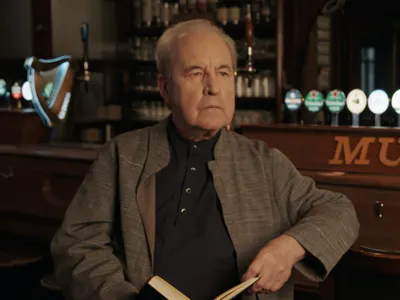
 John Banville on James Joyce's Dubliners
Which Dubliners Should You Read? A Guide to the Editions
with commentary by John Banville
If you want one answer: read the Penguin edition with Terence Brown's introduction and notes. The stories are short and the notes are long, and for this book that's the right ratio. The Oxford World's Classics, edited by Jeri Johnson, is the alternative, with the notes at the back and a map. The Norton Critical Edition prints Hans Walter Gabler's corrected text with the criticism. John Banville, whose Rebind series goes through all fifteen stories, doesn't name an edition. He does say, plainly, why a reader outside Dublin will want help.
Dubliners (1914) is the easiest of James Joyce's books to read and the hardest to read without notes. The sentences are plain. What's in them is Dublin in 1904: its streets, its priests, its politics, its slang, and a hundred small facts a Dubliner of the time would have known without being told. Banville is one. In Episode 13, on the story set in a committee room during a municipal election, he says what the rest of us are up against.
What Banville Says You're Up Against
"And nothing happens in the story, but that doesn't mean that it's not one of the great stories in the book. I mean, you would need, you know, half a page of footnotes for every page if you're not Irish and didn't know the period, you didn't know the politics of it. But it's worth looking into the background. Professor Google will tell you all about Charles Stewart Parnell. Professor Google knows everything."
The second thing is the English itself. In Episode 19, on "The Dead," Banville explains that the language of these stories is not quite the English of England:
"I think in different rhythms to the way in which an English writer would think, or the way in which an American or an Australian or a Canadian writer would think. And Joyce uses this special version of English, which the Irish developed. We call it Hiberno-English. And he uses it with such expertise, and especially in these stories, because he's in Dublin. He's only a year or two out of Dublin when he's writing these. Those Dublin voices are still vivid in his mind."
A good edition does for the reader what Banville does in the series: tells you who Parnell was, what a "goster" is, and why the men in the committee room are waiting for a dozen bottles of stout. It should also stay out of the way, because the stories are built on what isn't said. That is the case for notes at the back rather than on the page.
Which Text: 1914, Scholes, Gabler
Joyce finished the stories by 1907 and could not get them printed for seven years. Printers refused to set "Two Gallants." A publisher wanted "bloody" taken out of "Grace." In 1912 a Dublin firm destroyed the printed sheets. Banville tells it in the introduction film:
"I mean, at one point the printers broke up the type, and Joyce said that they burned the books. The printers said, no, we didn't. We just pulped them. Not much difference, really. He had extraordinary tenacity. He kept on through years, I mean, almost a decade."
The 1914 first edition that finally appeared was set from a mix of old proofs. It ignored a list of some two hundred corrections Joyce sent, and it replaced his dashes for dialogue with the quotation marks he called "perverted commas." So the text most free editions reprint is the one Joyce liked least. Robert Scholes's corrected text (1967) restored most of what he wanted and was the standard for thirty years. It is the text of the Viking Critical Library. Gabler's edition (1993) went back to the manuscripts and the late proofs and is printed by Vintage and by the Norton. The Rebind narrator reads from a text that keeps Joyce's dashes. If your copy opens "Two Gallants" with a dash rather than a quotation mark, you have a corrected text.
Penguin Modern Classics, Edited by Terence Brown
Brown's edition (1992) has the longest apparatus of any paperback Dubliners: an introduction, a note on the text, extensive endnotes, and appendices. It's the edition for a first read beside the series, because the notes answer the questions Banville says you'll have. Penguin keeps it in print in two formats, including a centennial edition with a foreword by Colum McCann.
Oxford World's Classics, Edited by Jeri Johnson
Johnson's Oxford (2000, reissued 2008) has explanatory notes at the back, a composition and publication history, and a map of Dublin. Two appendices add Joyce's own account of his trouble with publishers, "A Curious History," and the first version of "The Sisters" as it appeared in a farmers' magazine in 1904. Note numbers don't interrupt the text, which for these stories is a virtue.
Norton Critical Edition, Edited by Margot Norris
The Norton (2006) prints Gabler's text with his introduction to the publishing history, then contexts (photographs, newspaper pages, early versions of two stories) and eight critical essays on the most-taught stories. It is the edition for the argument about the book. One scholarly review found a share of the footnotes speculative. The text and the essays are the reason to own it. Vintage's paperback carries the same Gabler text with an afterword, for a reader who wants the corrected text without the classroom.
The Companions
Two books sit beside the stories. Don Gifford's Joyce Annotated (second edition, 1982) covers Dubliners and A Portrait with maps and is the standard reference. Jackson and McGinley's James Joyce's Dubliners: An Illustrated Edition with Annotations (1993) surrounds the text with photographs, tram tickets, and advertisements from the Dublin of 1904, and is out of print and worth finding. Neither is for a first read. Banville's series is a companion too, and his rule for it is in the committee-room episode: look things up, then come back to the talk, because "the talk is so idiomatic, the language is so idiomatic."
A Note on What to Avoid
Graded readers and simplified "young adult" versions, which exist for schools and strip the stories of the thing they're made of. "Annotated" print-on-demand editions with no editor's name, which are the free 1914 text with somebody's notes bolted on. And reading the stories out of order. Joyce arranged them from childhood to public life and ended on "The Dead," and the series takes them in that order for a reason.
Reading It with Banville
Banville was handed the book at twelve or thirteen by his older sister. In the introduction film he says he has "read the book, I suppose, every decade in my life." The series goes story by story, nineteen episodes for fifteen stories, with the text read aloud between his commentary. Start with the free introduction film. Then read Walking Blind Streets, the essay that opens the series, and listen to Episode 1, Handed the Book at Twelve, whose first five minutes are free. If Ulysses is where you're headed afterward, Should I Read Dubliners Before Ulysses? answers that. The Penguin in your hand, the notes at the back, and the dashes where Joyce put them.